
The most important research into purposeful movement.

As a part of our research into purposeful movement, understanding stimuli, and simply being on the quest to figure out purposeful movement for Rafael that does not rely on prompting or motor coaching, we have calmed through 40+ studies on intentional movement.
All of them were helpful to various degrees, but today we wanted to specifically highlight this study:
The Autonomic Nervous System Differentiates between Levels of Motor Intent and End Effector:
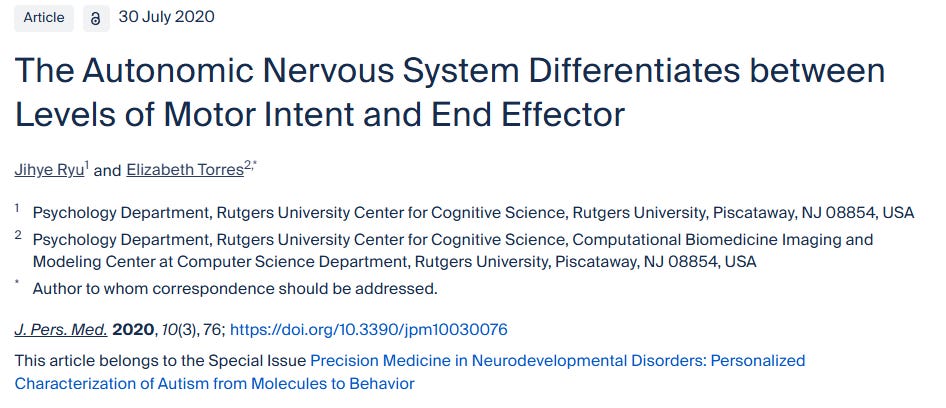
Before we look at the abstract, I want you to notice the authors.
Professor Elizabeth Torres PhD is a known researcher in non-speaking world, familiar with spelled communication who works with Elizabeth Bonker, founder and executive director of Communication 4 All.
We very closely follow her work: Elizabeth Torres is not only first class researcher on movement.
She knows and works with non-speakers, is a wealth of knowledge on the topic. And if she is looking into something... we’d better pay attention.
With that said, let’s look at the abstract of the study.
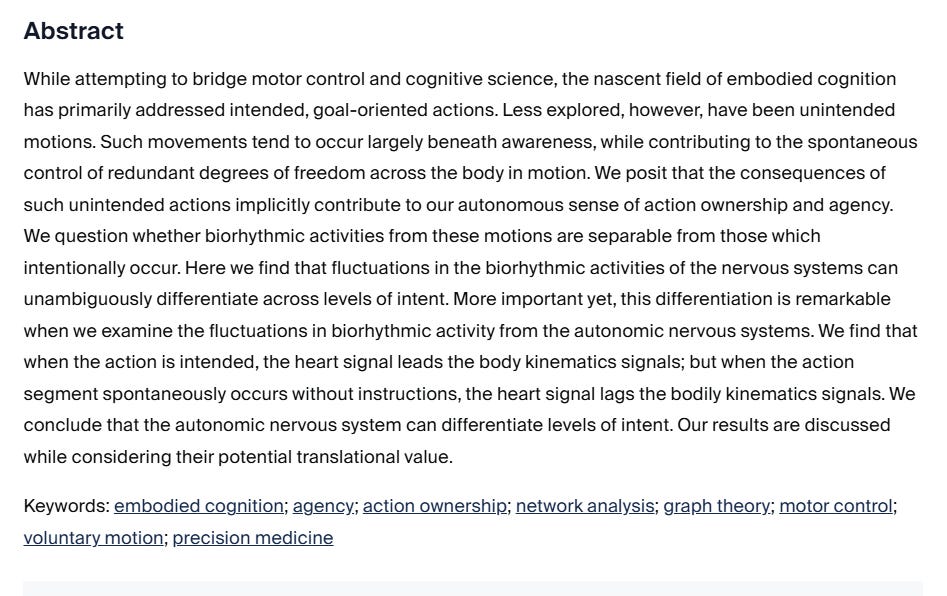
“...when the action is intended, the heart signal leads the body kinematics signals; but when the action segment spontaneously occurs without instructions, the heart signal lags the bodily kinematics signals.”
To be sure, this specific study is not non-speaker specific. It explores autonomic nervous system in its relation to movement.
But knowing that autonomic nervous system differentiates... (and perhaps plays role in) purposeful movement, gives us step towards purposeful movement.
Ok, Daria... so what do we do about this?
If you are a non-speaker, your interoception is very likely to be all over the place.
Many non-speakers talk about experience of feeling out of their body, their emotions being felt in their body, feeling emotions of other people (which emotions are interoceptive experiences).
And autonomic nervous system relies on your sensory information to function well, especially on interoception.
So the more we can support interoception, and therefore provide accurate information for your nervous, especially autonomic nervous system, the more we can support purposeful movement.
And we have proved it with Rafael lived experience:
“FEELING MY BODY’S BREATHING AND HEART BEAT LET ME MOVE MY BODY FINALLY ON MY OWN. - Rafael
To be sure, there is a huge difference between doing something with some amount of coaching and prompting, and completely on your own. Naturally, I’m not talking about influence here. Hopefully if you are here, you know better.
I’m talking about the fact that, responding to prompt or motor coaching still has stimuli based action in it, even if it is in line with what the person wants.
It is a very different matter when you as a non-speaker can get up and go and do something on your own without any support or guidance. This is where we want to get to. And we need our autonomic nervous system for it.
If you want to do this work with us, Get In Control, Non-Speaker! is where we support non-speakers and parents, starting with the FEEL Phase where we focus on all of the above and more.
p.s. And if you are a professional wanting to learn more about this, we will have something coming very soon. Join the waitlist here.
Additional reading:
The Motor Planning Revolution for Non-Speakers. - our foundational article on the topic that goes into purposeful movement vs stimuli based.
How to Feel Your Body Even if You Haven’t in Years: a Path for Non-Speakers to Improve Feeling and Get Moving on Purpose. - more on interoception and autonomic nervous system.
My question is why is intentional motor inconsistent from an autonomic nervous system perspective?
What is it about technology?
Why can they easily learn to select and play songs on YouTube for example?
Bc the positive feedback they receive (enjoyable video plays) outweighs the intentional motor exertion?
Whereas in daily tasks they don’t receive feedback as quickly? So for instance—learning to ride a bike—there is essentially zero immediate positive feedback when learning this. It takes several repetitive tries to even get started.
And this leads me to the emotional aspect of all of this. I think it would be really beneficial to have psychology and neuroscience working on this together. Not just assessing sensory processing or autonomic nervous system regulation but the emotions that inhibit nonspeakers’ intentional motor.
Technology actually is a very powerful stimuli. When we say stimuli based, it's not necessary always not intentional or automatic. It's simply to say the action is started in response to stimuli.
Screen and apps are super powerful stimuli with bright colors quick changes, etc. so you can learn it even when you don't have full access to volitional movement. This is a great question, and I'll make a mental note to write more on this.
Emotions are huge. Emotions are also sensory input affecting interoception greatly. I see it as a continuation of the same thing - emotions effect how we feel from the inside, create more sensory uncertainty and yes, very much impede international movement. This is something we address in depth in Get In Control, Non-Speaker!